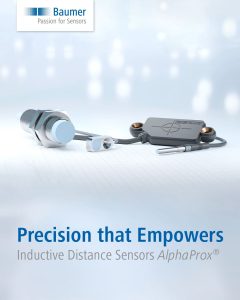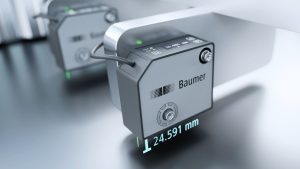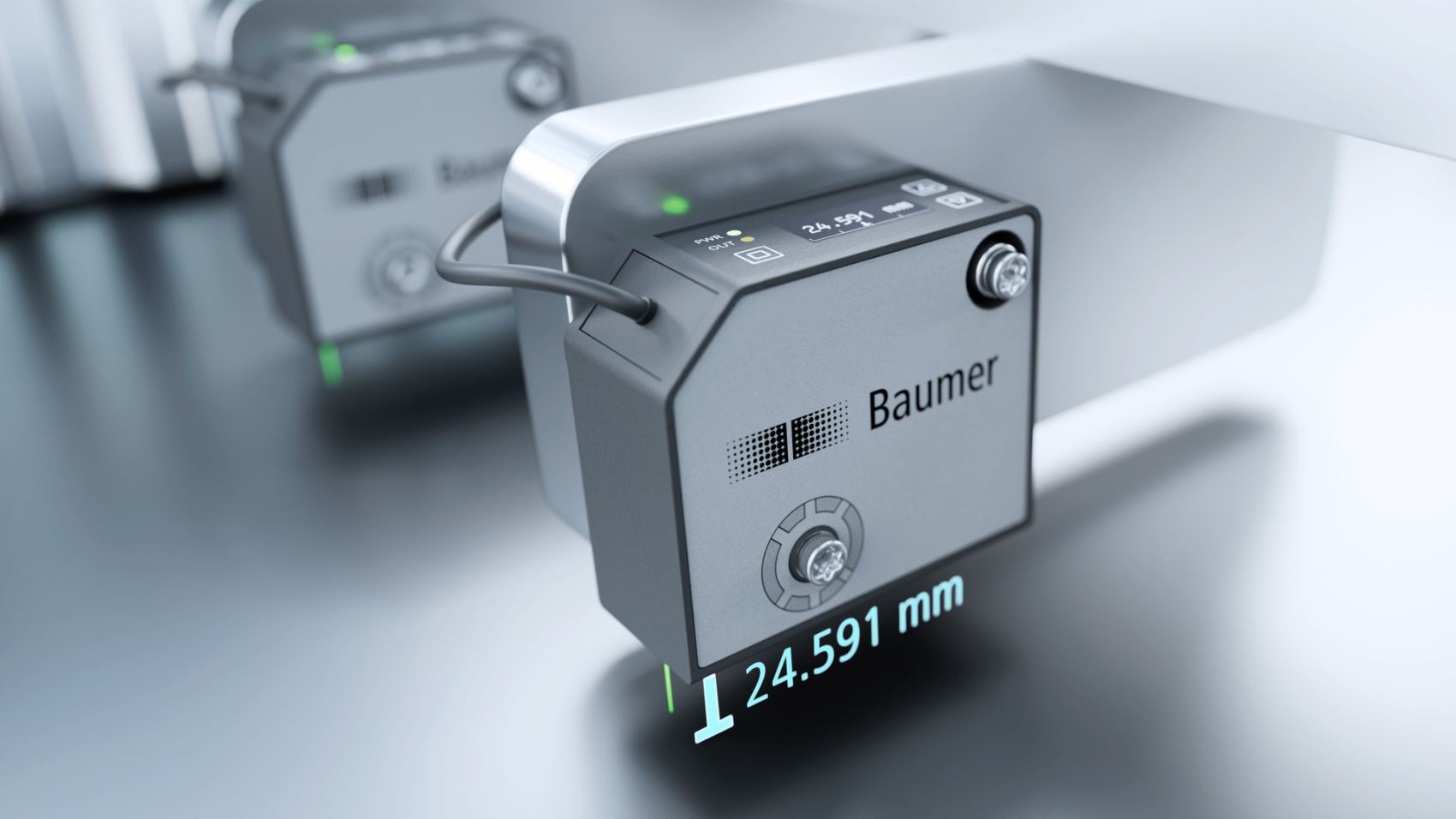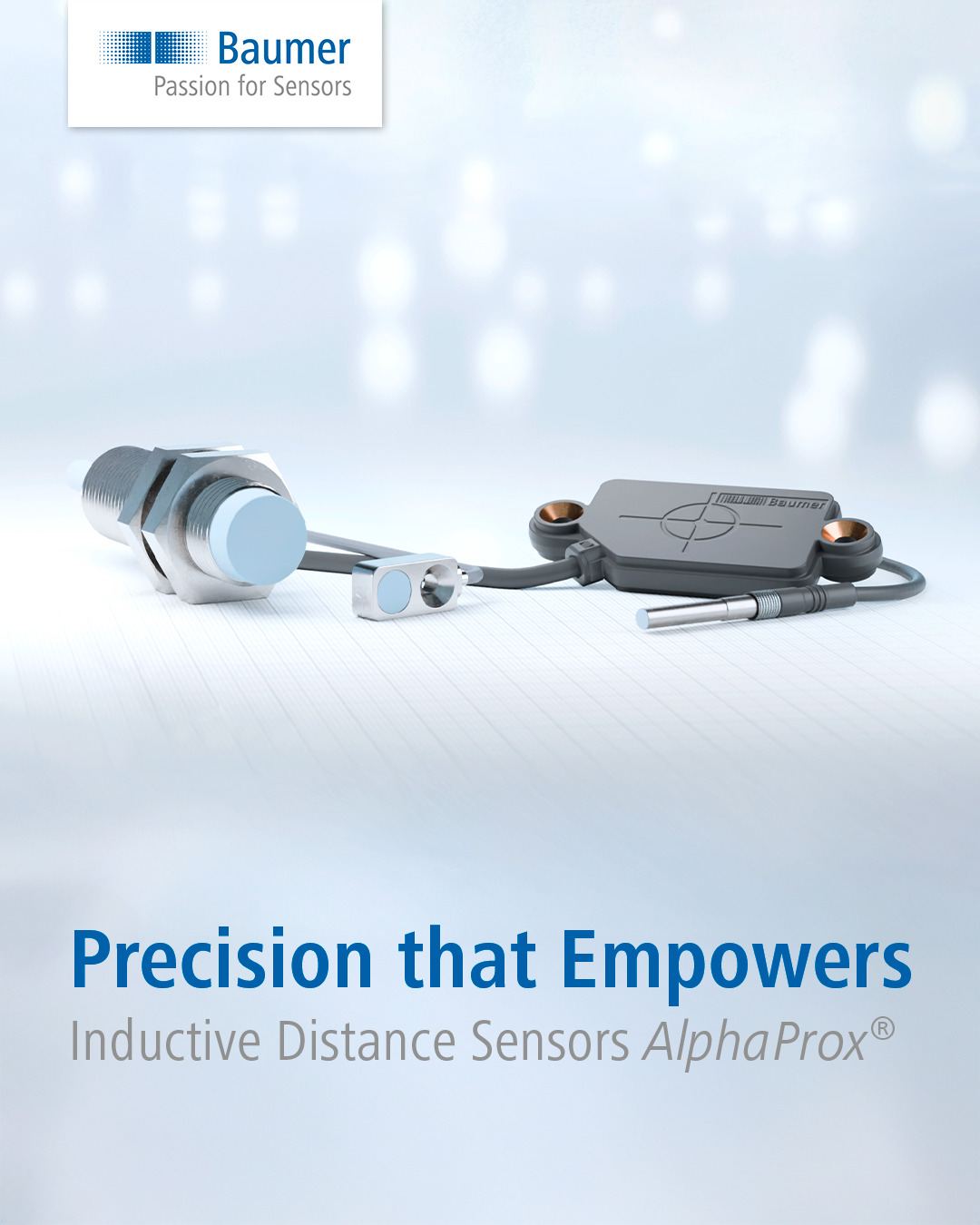
Do you need to know not only whether a metal component is present, but also where it is positioned? Baumer AlphaProx® inductive distance sensors deliver a continuous measurement value. Compact designs and analog or IO-Link versions open up applications in machine design and condition monitoring.
Which AlphaProx suits your measurement task? Target material, displacement, installation space and controller interface must be considered together. This guide helps prepare the selection; the exact ordering version must be checked against its own datasheet. Links to the original manufacturer PDFs are provided below.
Contents
- Measurement principle
- Resolution and linearity
- Designs and selection
- Tool clamping in motor spindles
- Vibrating feeders
- Further applications
- Analog or IO-Link
- Frequently asked questions
- Manufacturer documentation
- Selection support
Measure rather than switch – more information about the process
A conventional inductive proximity switch indicates a defined state: the target is within the switching range, or it is not. A measuring inductive sensor instead follows changes in the distance to a metallic target. The controller can use the continuous value to evaluate position, displacement or an application-specific operating state.
AlphaProx is not limited to targets approaching along the sensor axis. With a suitable target geometry, lateral displacement and angular position can also be determined. Force and strain can be measured indirectly: the sensor detects the displacement caused by loading, which can then be evaluated using the mechanical system’s established relationship. This requires an appropriate geometry and application-specific calibration.
Precision: resolution, linearity and temperature
Baumer’s family factsheet highlights resolution down to 4 nm and linearity down to 5 µm. Its high-resolution IPRM 12 example is listed at < 0.004 µm, equivalent to < 4 nm; this is not a specification for every AlphaProx version. Resolution and linearity describe different characteristics: fine resolution alone does not make the overall installed measurement accurate to a few nanometers. Measuring range, linearity, temperature behavior and dynamic performance must be considered together for the selected version.
The portfolio includes solutions using temperature compensation and end-of-line calibration. In the application, the machine mechanics, mounting, metallic target and environmental conditions also matter. The best family-level figures are not combined specifications applying to every version.
Compact and application-specific designs
Cylindrical, threaded and rectangular designs suit different mounting arrangements. Small housings are especially useful in motor spindles, clamps and compact machine assemblies. The examples below come from Baumer’s AlphaProx family factsheet; select the exact ordering version using its individual datasheet.
Where should selection start?
- Limited space? Check housing dimensions and the required measuring distance first.
- Measuring small movements? Evaluate resolution together with linearity, temperature behavior and dynamic performance.
- Considering IO-Link? Verify the interface and available functions for the exact ordering code.
| Family / designation | Size listed in factsheet | Measuring distance | Resolution |
|---|---|---|---|
| IWRM 04 | Ø 4 mm | 1 mm | < 1 µm |
| IR06 | Ø 6.5 mm | 3 mm | < 1 µm |
| IR12 / M12 | M12 | 6 mm | < 1 µm |
| IR18 / M18 | M18 | 15 mm | < 5 µm |
| IR30 / M30 | M30 | 24 mm | < 5 µm |
| IF08.D02S | 8 × 4.7 mm | 2 mm | < 1 µm |
| IR12.D03K, high sensitivity | M12 | 3 mm | < 0.25 µm |
| IPRM 12, high resolution | M12 | 3 mm | < 0.004 µm |
The table lists family designations, not complete ordering codes; it is not a complete portfolio or stock list. The size entries follow the factsheet table and do not necessarily specify every overall housing dimension. Interfaces, linearization, teach-in and environmental versions depend on the selected type. The portfolio also includes factor 1, off-highway, washdown and high-pressure versions.
Need help choosing? Describe the application, target material, working distance and displacement, available space, interface and environment: Request selection support · +36 1 4310 130.
1. Tool clamping and drawbar position in motor spindles
During automatic tool changes, the controller needs to identify the clamping state: open, closed without a tool, or closed with a tool. Separate switching sensors can provide this information. Baumer’s technical report describes another approach: an inductive distance sensor follows a tapered measuring surface on the drawbar, and the controller evaluates the state from the measured distances.
Potential benefits include a smaller installation space, fewer mounting points and continuous observation of clamping. The measurement can also be used to examine small deviations from the normal position. In the manufacturer’s example, chips between the tool and spindle or changes in clamping can cause such deviations. Target design, measuring range and controller thresholds remain part of the application: this is not a direct drop-in replacement in every machine.
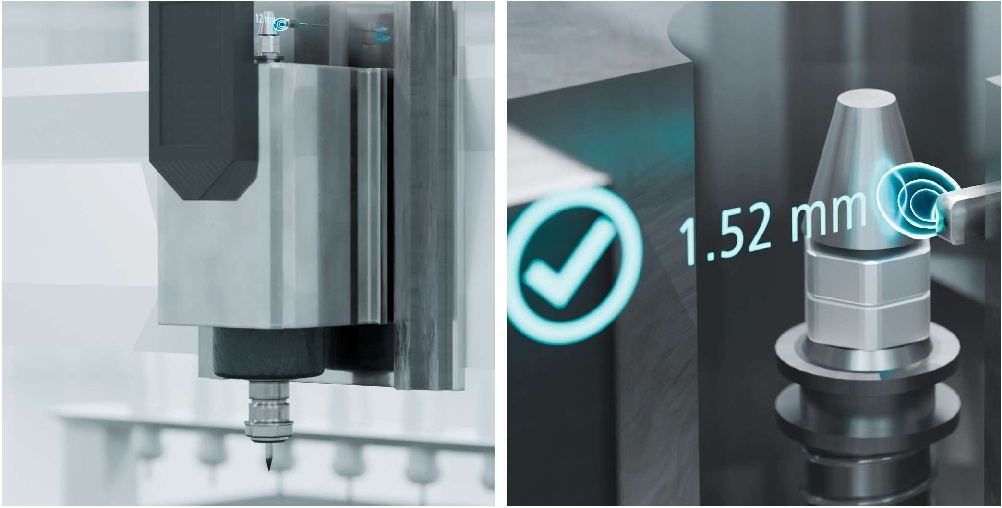
Baumer manufacturer illustration – “Effective tool change cleverly designed with inductive miniature sensors”, page 1.
2. Vibrating feeders – distance is not the only useful signal
In vibrating feeders and rotating machine assemblies, suitable IO-Link inductive sensors can supply frequency or counting information. Baumer’s “Inductive sensors: Can do more than expected” report describes measured frequencies up to 1.2 kHz. This is the frequency of the signal measured by the documented versions, not the response frequency or IO-Link cycle time of every AlphaProx. Considering frequency together with motion characteristics can help evaluate the feeding process.
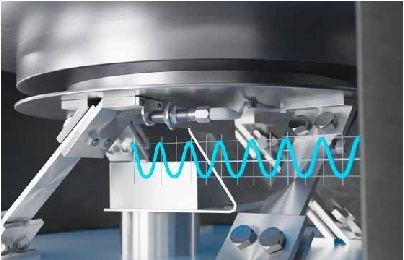
Baumer manufacturer illustration – “Inductive sensors: Can do more than expected”, page 3.
Further applications from manufacturer reports
Determining load from displacement in a crane structure
One manufacturer application determines weight or load on a heavy-duty crane without placing the measuring element directly in the force path. Instead, an inductive distance sensor measures the small structural deflection caused by the suspended load. With a properly calibrated mechanical relationship, this displacement can be used to estimate loading.
The approach is particularly interesting where a small structural movement is accessible and can be measured reproducibly. Measuring range, temperature, the mechanical condition of the machine and applicable safety requirements influence the solution beyond the sensor selection itself.
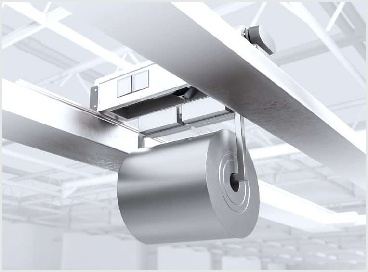
Baumer manufacturer illustration – “5 astonishing solutions with precision sensors”, page 2.
Monitoring strain and vibration in wind turbines
Loading on a wind turbine blade produces stretching or compression. In Baumer’s example, the distance between a metal measuring element and a precision inductive sensor changes between two nearby attachment points. This small displacement can provide information about mechanical loading.
Vibration and other secondary data from suitable IO-Link versions may also support condition monitoring. A changing signal can be a useful starting point for maintenance investigations, but one sensor reading alone is not an automatic fault diagnosis.
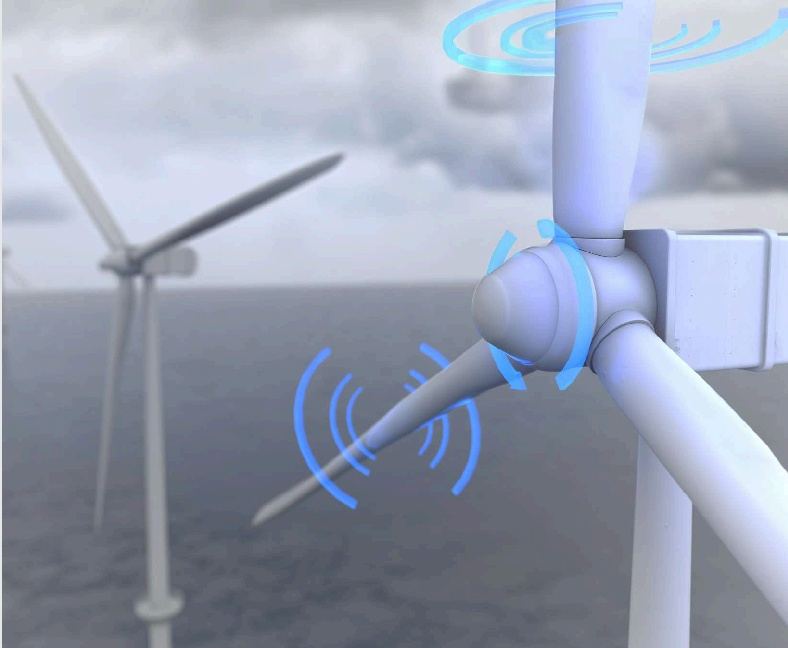
Baumer manufacturer illustration – “5 astonishing solutions with precision sensors”, page 3.
Cutting blades and small angular movements
Another manufacturer example follows the geometry of cutting blades during operation. Changes in the blade-head width can provide information about sharpening condition, helping maintenance decisions move beyond a fixed time interval. Measurement arrangement, signal processing and filtering are important here too.
Miniature sensors can also be incorporated into arrangements for tracking small angular movements. Baumer illustrates this with a microprocessor-controlled knee prosthesis, where distance measurement is used to infer joint position. This demonstrates miniaturization possibilities; the requirements of the final equipment must be addressed separately.
Analog or IO-Link? Plan the integration as well
With an analog interface, controller input resolution and signal-transmission conditions also matter. IO-Link versions can add digital measured values, parameterization, filtering settings and type-specific diagnostic data. The signal reaches the controller through a suitable IO-Link master.
Baumer Sensor Suite helps evaluate and configure compatible devices. When choosing filtering, consider signal smoothing, resolution and response time together. The report describes temperature data, operating-time or cycle information and a 16-bin histogram for certain versions in Baumer’s broader inductive portfolio. These are not functions of every AlphaProx; check the selected model’s documentation for its available data.
Baumer manufacturer illustration – “Inductive sensors: Can do more than expected”, page 1.
Frequently asked questions before selection
Does 4 nm resolution mean 4 nm measurement accuracy?
No. Resolution describes the ability to distinguish small changes; overall system accuracy also depends on linearity, temperature, the target and installation. The IPRM 12 example is not a general specification for every version.
Does every AlphaProx have IO-Link?
No. The portfolio includes analog and IO-Link versions. Check the datasheet for the complete ordering code to confirm the interface and functions needed by your controller.
Is 1.2 kHz the response frequency of the whole AlphaProx family?
No. The report describes a frequency-measurement function on the documented inductive versions. Response time, filtering and data-transfer cycle must be checked separately for your application.
Baumer technical documents – explore the details
The following English-language manufacturer documents are listed on Baumer’s official website. This article is an edited overview; the application examples are not Virtech customer projects.
- AlphaProx family overview factsheet (PDF, EN)
- Five applications using precision inductive sensors (PDF, EN)
- Inductive sensors: Can do more than expected (PDF, EN)
- Further manufacturer material, including the miniature-sensor tool-change report – AlphaProx product page and downloads (EN)
Need help selecting an AlphaProx sensor?
Describe the application, target material, working distance and displacement, available space, interface and environment. Virtech Sensor can help select a suitable version for your application in Hungary.